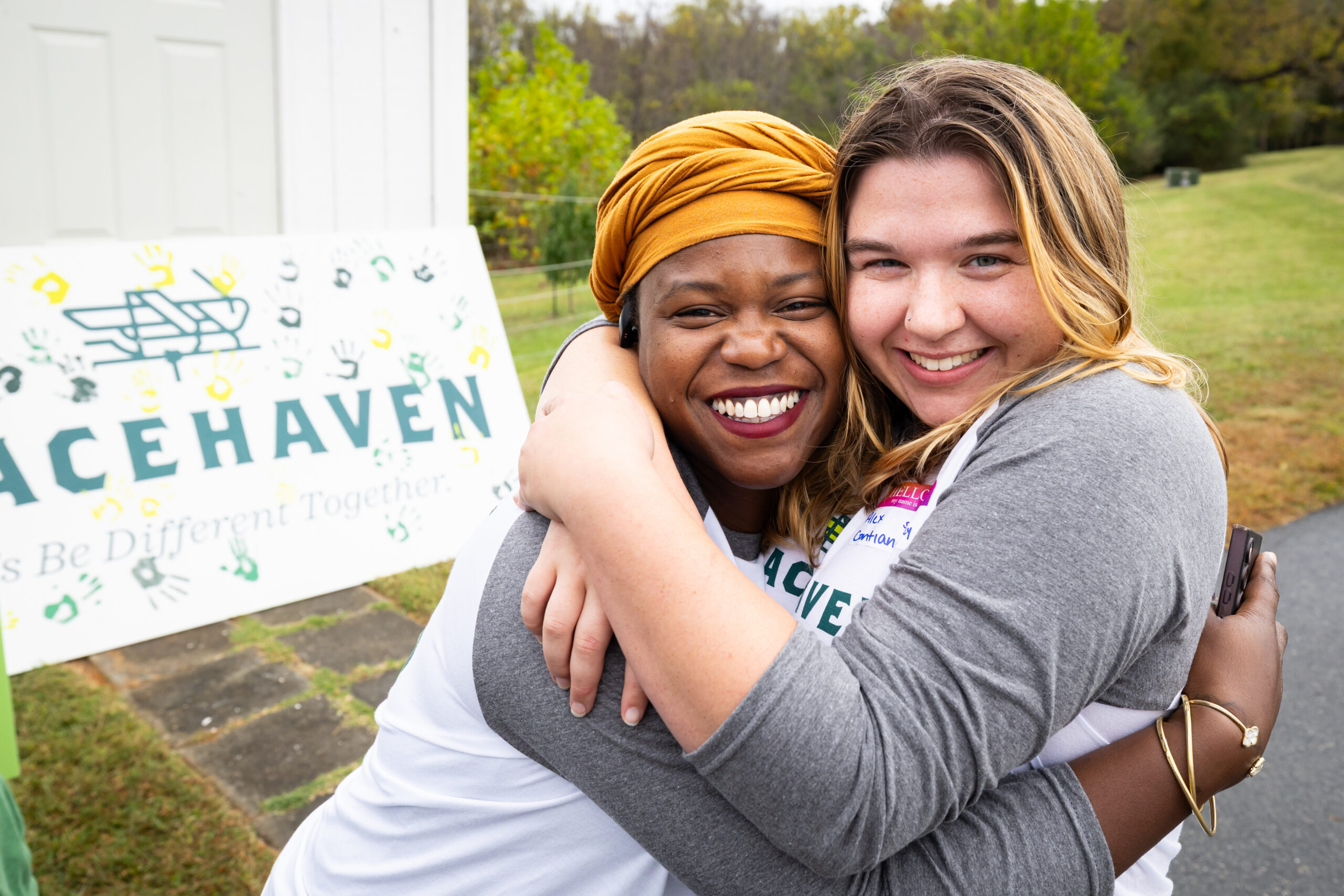
A Triad nonprofit plans a unique housing development that celebrates people’s differences.
02/27/2026
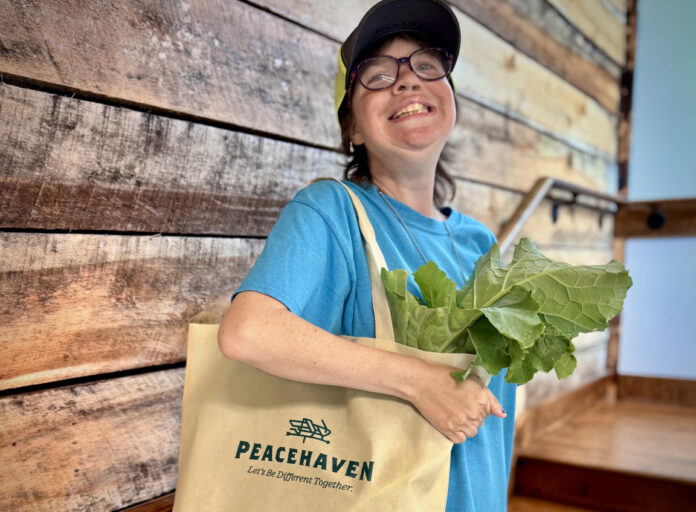
Peacehaven Farm envisions a diverse community that honors the disabled. Is the world ready?
While the world in general bubbles and boils with endless conflict, a small nonprofit based northeast of Greensboro wonders why we can’t set aside our differences and get along.
And not just get along, but live together. Literally. Like next door, in the same neighborhood.
Peacehaven Farm is a charitable organization focused on improving the lives of adults with intellectual/developmental disabilities (I/DD). It is building a unique residential community on an 89-acre farm just south of I-40/85 between Greensboro and Burlington. The development will include a 22,000-square-foot community center that is under construction and expected to open in 2027. Plans call for eventually adding a medical clinic, classroom space, a working farm and housing for a diverse community of about 200 people. Construction on the first home is likely to start by 2029, and folks moving in by 2030. Details on the size and cost of homes are not finalized.
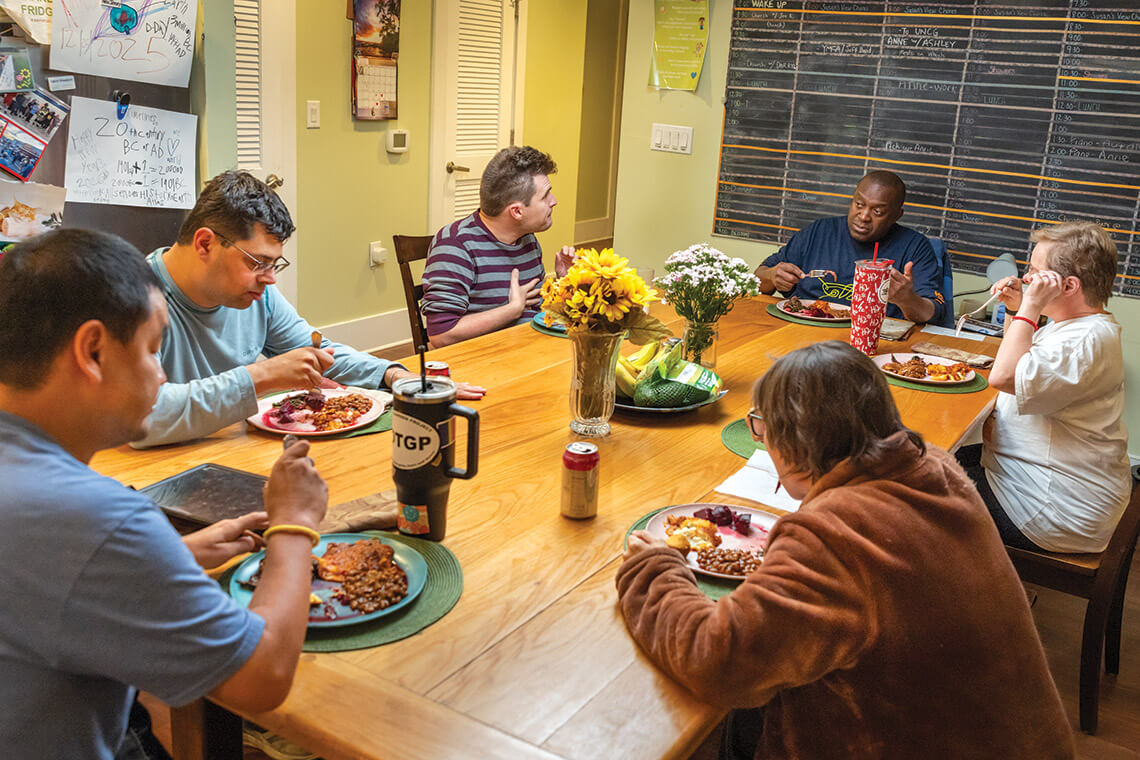
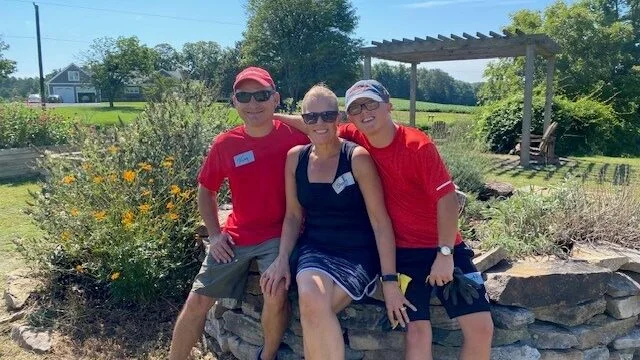
By design, about 40% of the population will consist of adults with I/DD of all descriptions. They’ll be nestled amongst a bunch of folks of more common ability who choose to live in a beautiful rural setting and a community that embraces “being different together.”
“Normal people” living alongside I/DD? On purpose? Neal Sharpe, Peacehaven’s chief operating officer, notes that Peacehaven’s basic proposition takes some getting used to.
“It does produce some odd expressions on people’s faces,” he says. “But, if you think about it, it’s not that different from the way the world operates now. There are always neighbors who are different. Some of them may be adults with I/DD. The difference here is that this is more intentional. We think this is a better way for everyone.”
It will certainly be better for the 80 or so I/DD adults who will live at Peacehaven. They typically require life-living assistance, supervision, or even round-the-clock care, and face myriad challenges. When they turn 22, they are no longer eligible to attend public schools.
That cut-off, known as “The Cliff” in the I/DD world, eliminates an important source of social integration and daily structure. Most I/DD individuals are mainstreamed in public schools these days, attending classes and participating in activities with the general population. That has been the law since the federal individuals with Disabilities Education Act passed in 1975.
When those individuals go over “The Cliff,” their world changes. Many withdraw into a tiny world populated by only their closest relatives. The result is not positive, says Peacehaven CEO Phelps Sprinkle, who is the father of Roxie, an I/DD child.
“Life becomes more difficult in so many ways,” he says. “Mental health issues spike and then things often spiral from there. It’s one of the biggest problems — maybe the biggest problem — that I/DD adults face.”
That is why Peacehaven exists.
“What we’re doing here,” says Sprinkle, “is solving for isolation.”
Founder’s vision

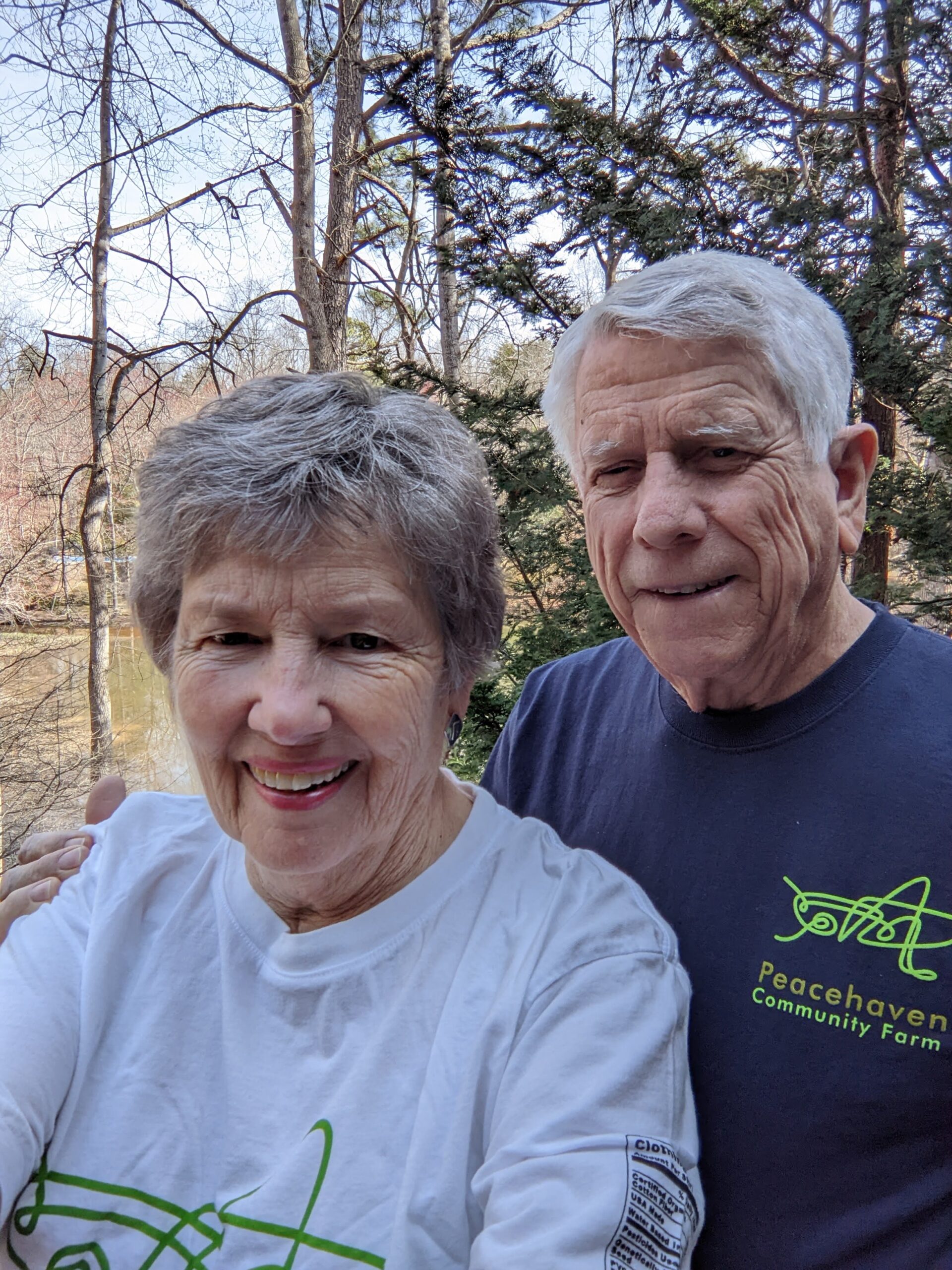
Peacehaven Farm is the result of the hopes and dreams of two couples: Buck and Cathy Cochran of Greensboro, and Tim and Susan Elliott. The couples met through their children, both ID/D kids at a Greensboro school specializing in such instruction.
Both families saw “The Cliff”approaching. As a response, Susan Elliott had a vision of a residence for I/DD adults in a peaceful rural setting. Through relentless prospecting in her trusty Volvo station wagon, she found a spot off N.C. 61 in eastern Guilford County: An 89-acre former farm that was for sale by a developer whose plans hadn’t worked out.
Cochran, a Baptist church minister, and his wife, a counselor, brought passion and expertise to the project. Tim Elliott provided the financial muscle. He had been a top executive in the West Virginia-based coal company owned by the late Chris Cline. A major gift from Cline, a billionaire who died in a plane crash in 2019, helped fund the land purchase and some initial operations.
Peacehaven opened a small group home for about a dozen individuals, based in an old farmhouse on the property, in 2014. It has added day services, including a small country store/produce stand manned in part by I/DD staff, while developing plans for the residential community. A loyal community of supporters and donors is coalesced around the project’s inclusive ideals.
“We didn’t know what this would be, but it’s just become the best place,” says Buck Cochran.
A growing ‘business‘
A decidedly charitable vibe flows over the rolling hills at Peacehaven, even as construction carves roads through the red dirt fields and the community center takes shape. Everyone is exceedingly nice to their fellow humans.
Below the surface, however, a business mentality persists. Peacehaven’s non-profit designation “is nothing but a tax status. We have to think about how to best use our profits, just like any business,” Sharpe says. “The difference is that we won’t give (the profits) back to shareholders, or our officers.”
It’s growing into a much larger business. The construction project will cost $70 million, and the $3 million annual operating budget is expected to triple in the next few years, to more than $10 million. The payroll is also expected to increase to more than 100 when the homes are completed.
About $20 million of the construction budget has been raised so far. Those donating more than $1 million include the state of North Carolina, State Employees’ Credit Union, The Graham Foundation of Greenville, South Carolina, the Elliott family, and Trillium Health.
Greenville, North Carolina-based Trillium is one of three managed-care organizations that manage insurance reimbursements for serious mental health, substance use, traumatic brain injury and I/DD services. Trillium is supporting Peacehaven because of the expected savings from the reduction in mental health services for its residents and customers. Three other MCOs are also partners, but have not matched Trillium’s financial commitment.
About 80% of Peacehaven’s current revenue comes from donors, but that will change significantly through the residential expansion.
Medicaid payments, which Peacehaven was cautious in embracing, are expected to eventually make up about 50% of revenue. Fees for services, including rental income from the residences, and donations will make up the rest. The residential property may eventually be funnelled through a for-profit corporation under the Peacehaven umbrella.
“Ideally, Medicaid would not be the majority of our revenue,” says Cory Phillips, Peacehaven’s director of advancement. “Many great organizations find themselves dependent on Medicaid, and when the political climate changes that can be a problem.”
Need far outstrips funds when it comes to government funding for I/DD support. A small percentage of families with I/DD adults qualify for Medicaid funding. The North Carolina Innovation Waiver allows families with an income of as much as $184,000 to receive Medicaid support. The waivers are based on acuity of need, but available funds determine how many waivers are granted. Consequently, nearly 18,000 are on the waiver waiting list. Just more than 14,000 receive the waivers, and the accompanying funds.
The application process is tedious. Peacehaven’s Sprinkle says there may be another 60,000 who could qualify but don’t want to enter a bureaucratic black hole.
Peacehaven will also realize income from renting event space, and from partnerships with local colleges. UNC Greensboro, North Carolina A&T, Elon University and UNC Chapel Hill are onboard for some programs at the Peacehaven campus. One partner is expected to add a Disability Studies Minor, built around the Peacehaven program.
A handful of residential spaces might be reserved for students on a short-term basis, similar to a semester abroad.
Phillips says the idea is for fee-based revenue to be driven by a combination of utility and altruism. Beyond its beautiful setting, “we think there are plenty of people who’d love to know their wedding benefitted a ton of very deserving individuals.”
Dunbar’s number
The number of residents will be capped at 200, though current zoning would allow for 1,000 or more. That limit is based on “Dunbar’s Number,” a figure devised by British anthropologist Robin Dunbar suggesting that meaningful community stopped above 150 people or so. Beyond that point, new tribes or groups form.
As noted, however, community needs outstrips available services.
About 4% of adults qualify as I/DD, with about 53,000 I/DD individuals within a 60-minute drive of Peacehaven. If the drive time is expanded to 90 minutes, which includes Charlotte and Raleigh, the number climbs to 200,000.
“Some say, ‘Well, why not build 500 or 1,000 spaces to serve all I/DD, the need is there,’” says Sprinkle. “But we don’t think that’s a model that really changes this world. That’s what we’re about, hopefully, is building that model.”
Peacehaven officials consider the initial development to be a model. They hope to expand to dozens of other sites across the state, with new communities falling under the Peacehaven umbrella. Or they hope other groups follow, inspired by the farm at Whitsett.
Peacehaven’s leaders are asking state leaders to consider the concept’s potential economic benefits, including savings on mental health care and driving worker productivity. Many families with I/DD adults work less than they otherwise might if they weren’t focused full time on caring for their adult child. Some caregivers also suffer from mental health problems, given the obvious pressures.
“We don’t know which way it will work out,” says Sprinkle. “We’d love to be able to do more communities on our own.
“That said, if someone else sees this and wants to do their own, we’re going to help them every way we can,” he says. “We want to get this right. There is so much need. This will change so many lives. I wake up every day ready to go to work because I don’t want to screw up for all our people out there.” ■